
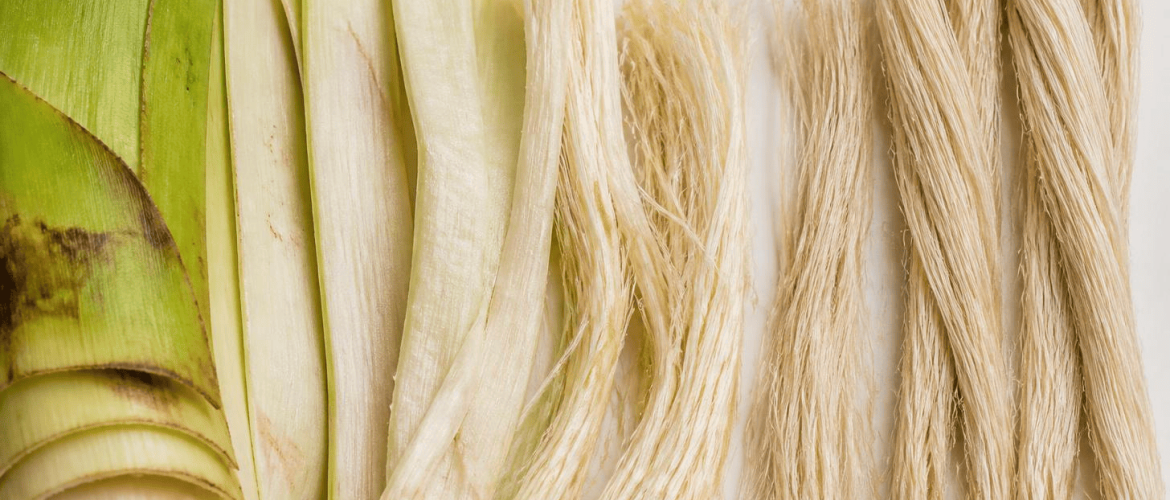
Banana fiber or silk (extracted primarily from the pseudo-stem of the banana plant, Musa acuminata) is a highly durable, lightweight, and versatile natural lignocellulosic fiber.
It features a unique cellular structure that results in high moisture absorption, excellent tensile strength, and a naturally shiny sheen often referred to as “banana silk”.
Chemical Composition-
The chemical matrix directly dictates how the fiber behaves during chemical treatments, bleaching, and spinning.
- Cellulose: 60% to 65% (Provides the primary structural backbone and strength)
- Lignin: 5% to 10% (Offers rigidity; higher concentrations are found in lower industrial grades)
- Hemicellulose: 6% to 19%
- Pectin: 3% to 5%
- Moisture Content: 10% to 12% (Under standard ambient conditions)
Physical & Structural Properties
Banana fiber behaves similarly to bamboo or ramie fiber, offering a unique blend of ruggedness and softness depending on how it is processed.
- Average Diameter / Fineness: 50 to 250 μm (Roughly 17 to 25 Tex; can be chemically refined down to lower deniers for apparel spinning)
- Fiber Length: Commonly extracted in long strands ranging from 1 meter to 3 meters (For textile spinning, it is typically staple-cut to 28mm–38mm lengths).
- Density: ~1350 kg/m³ (Lightweight compared to glass fiber, making it highly competitive for composites).
- Color: Varies by extraction grade. Grade A (Premium) yields a brilliant cream/off-white; Grade B is a light tan/gold; Grade C (Industrial) is a dull brown.
Mechanical & Performance Properties
- Tensile Strength: High specific strength, typically ranging from 500 to 750 MPa (Significantly stronger than banana leaf or pseudo-stem skin alternatives).
- Elongation at Break: ~1.5% to 3.5% (A relatively low-stretch, highly stable rigid fiber).
- Young’s Modulus: 28 to 32 GPa (Provides high stiffness relative to its mass).
- Thermal Stability: Stable up to approximately 220°C, making it compatible with thermoplastic matrices (like PP or PLA) during biocomposite extrusion.
Standard Grading Categories-
Commercial banana fiber specifications are generally divided into three processing classes:
Specifications Grade A (Textile / Premium)
Grade B (Standard / Twine)
Grade C (Industrial / Composite)
Primary Color Cream / Shiny Off-white Light Golden / Tan Dark Brown / Dull
Texture Soft, clean, minimal pith Medium stiffness, minimal dust Coarse, higher rigid lignin content.
Main Uses Fine apparel, “Banana Silk” luxury paper Ropes, handicraft mats, coarse yarn Biocomposites, concrete reinforcement, auto parts.
One quintal
A grade- 700 USD
B grade- 650 USD